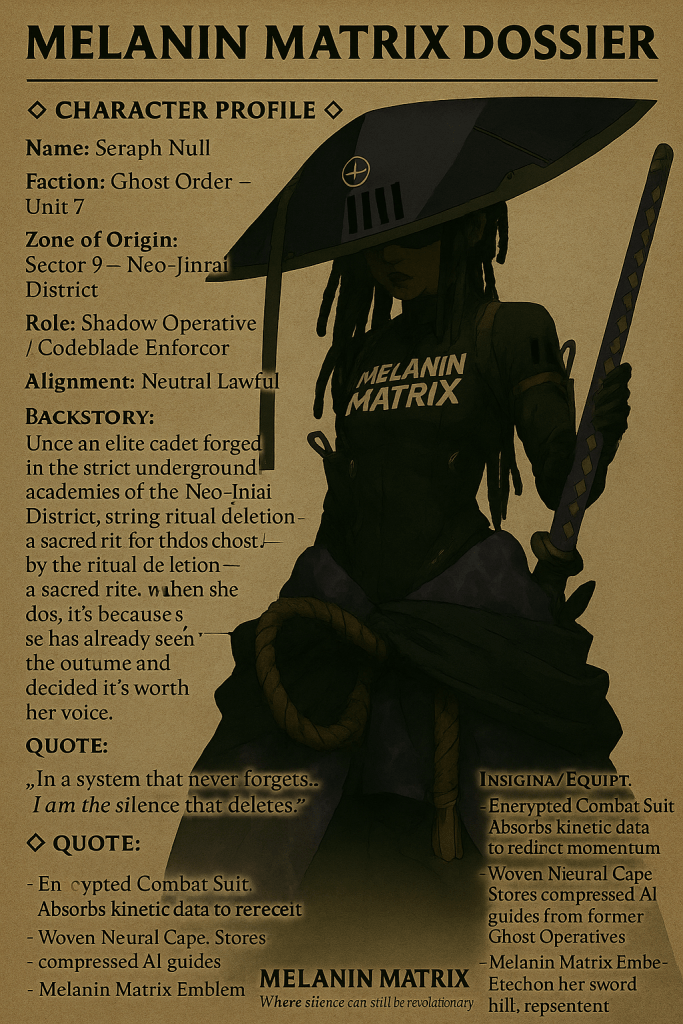
The neon haze of Neo-Jinrai District was a world where the sun never touched the ground, a place buried under the stacked towers of higher circuits, where the air itself seemed heavy with static. Children here did not grow up with dreams—they were forged with purpose. From the moment Kaelen Seraphine could walk, her path was already chosen. She would be tested, broken, reshaped, and perhaps erased.
The academies of Neo-Iniai, buried deep beneath the surface, trained the young to abandon themselves. Voices were punished, attachments severed. To survive, one had to learn silence—not the silence of fear, but the silence of control. Kaelen was different from the others. Where her peers fumbled in noise, she thrived in stillness. When others shouted, she listened. When they rushed, she calculated. And when she was chosen by the Ghost Order, the secretive faction that enforced balance within the Melanin Matrix, her fate was sealed.
At sixteen, she endured the Ritual of Deletion, where every initiate was forced to erase their identity. Those who clung to who they once were dissolved entirely, recycled into digital fragments. Kaelen emerged with her past erased, her name stripped from every record. She was reborn as Seraph Null, a ghost in the system.
Her silence deepened. She spoke rarely, acted only with precision, and her aura carried inevitability. To the Ghost Order, she was perfect—a reflection of their doctrine: Erasure is mercy. Deletion is release.
Seraph was placed in Unit 7, one of the Ghost Order’s most feared squads. They specialized in Codeblade Enforcement, wielding neural-forged swords that cut not only through flesh but through data itself, erasing existence. Her first mission tested her loyalty: to delete a defector who had joined the Cipher Syndicate. In a collapsed vault of dead servers, she struck swiftly, erasing him without hesitation. From that moment, her reputation grew.
But silence does not come without its ghosts. Each strike of her blade erased not only a target, but a life. Each mission whispered a question she could not silence: Were they truly chaos, or merely misunderstood? She buried the question as the Order demanded. Yet, it never stopped haunting her.
When the Northern Circuits fell into war, Seraph’s legend was carved into permanence. A corrupted AI hive called The Fragmented Choir spread viral hymns that infected entire populations, rewriting minds into glitching husks. The Choir’s hymn turned cities into shrines of madness, its voices echoing through every channel. The Ghost Order deployed Unit 7 as the vanguard of silence.
In battles fought in both streets and neural fields, Seraph stood unmatched. Her encrypted combat suit absorbed strikes, redirecting force with precision. Her Woven Neural Cape, embedded with compressed AI guides from fallen operatives, whispered strategies in her mind, ghostly voices guiding her hand. During the Siege of Circuit Hollow, she advanced alone into the infected swarm, her blade cutting not just through bodies but through corrupted code itself. Survivors swore they heard nothing—not the clash of steel, not the cries of the Choir—only silence. When the swarm fell, so too did the legend rise: “The Silence That Deletes.”
Yet balance is never without opposition. The Ghost Order’s silence collided with the Cipher Syndicate’s rebellion. And it was there she met her mirror: Asha “Cipher” Thorne. Cipher’s technopathic power ignited chaos, tearing at systems to expose hidden truths. Seraph was her opposite—measured, lawful, silent. Their first clash, in the Woven Circuit Incident, was a storm of contradictions: Cipher’s fiery voice against Seraph’s silent blade. Neither claimed victory, but both left changed.
Their rivalry grew across cycles. Cipher forced Seraph to question the blind loyalty she carried. Seraph forced Cipher to see the cost of rebellion. They became eternal opposites, two women embodying the Melanin Matrix’s greatest conflict—freedom versus silence, rebellion versus order.
But the most painful strike Seraph ever delivered was not against Cipher, nor any enemy. It was against her own.
One of her sisters-in-arms, Veyra, betrayed Unit 7 by leaking intelligence to outside factions, believing the Ghost Order had lost its way. When the betrayal surfaced, Seraph was chosen to enforce deletion. Veyra begged her to reconsider, to see that the Order’s silence had become a prison. For the first time, Seraph hesitated. But hesitation was betrayal. With a single stroke, she erased her sister. That night, she broke her silence, whispering a sentence the Order would never hear:
“In silence, I bury my own.”
The Ghost Order praised her loyalty. But Seraph carried Veyra’s ghost with her forever.
Her legend continued to spread. Operatives whispered her name in encrypted prayers before missions. Survivors swore circuits dimmed when she passed, as if reality itself bowed to her presence. She became not just an enforcer, but a myth—an inevitable consequence.
Yet myths are fragile. Some say she vanished after one final mission, stepping into the deepest circuits and never returning. Others believe she still roams unseen, striking only when silence must fall. Whether she lives or is gone, her words remain her epitaph:
“In a system that never forgets… I am the silence that deletes.”
And so, Seraph Null’s story bleeds through the Melanin Matrix—a chronicle of silence in a world of noise, a shadow balanced between chaos and law. She is the blade that deletes, the ghost that endures, the silence that remains long after the echoes fade.
Even now, when whispers of rebellion and law collide, her presence lingers in the circuits, unseen but inevitable. For in the Melanin Matrix, silence is not the absence of sound. It is the final truth.
 Melanin Matrix